Showing posts with label wat mahathat. Show all posts

Sunday, May 04, 2008

261206 Wat Mahathat miscellaneous

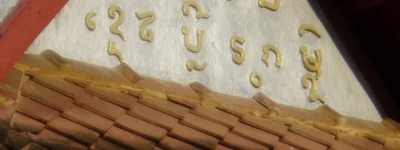
Tham alphabet soup on the alarm clock:

PC260411a

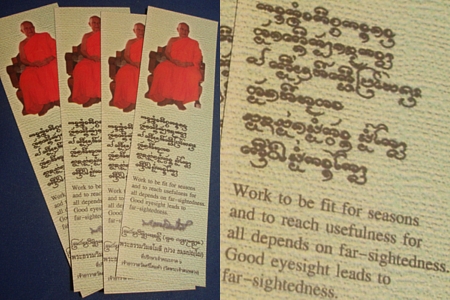
The cat first came across this alphabet when a novice monk in Phayao gave it several bookmarks with a quote from a famous monk written in Tham script, with an accompanying Thai-glish translation:

P2240276b

In this case people in Singapore (& Taiwan & Hong Kong) should be really crap at longterm planning since the country has one of the highest prevalence of myopia in the world (28% of 7 y/o kids & >80% of 18 y/o teens are shortsighted). A lot more detail on Tham script here.

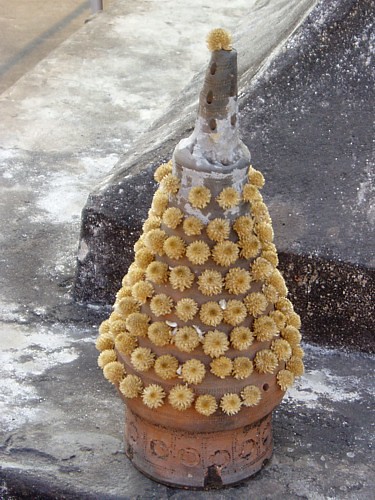
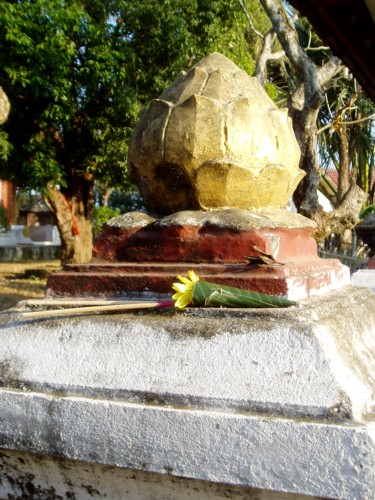
A lotus bud(?) that looks more like a golden artichoke to the cat's myopic eyes:

PC260010

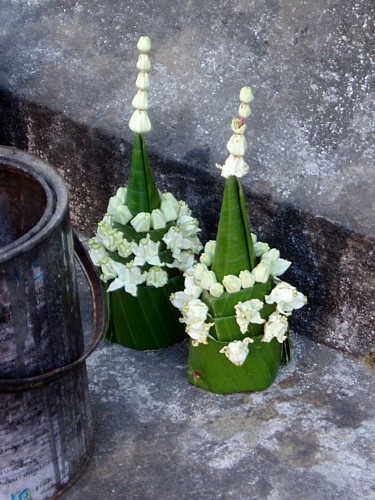
With the Lao version of temaki sushi (using banana leaf in place of seaweed) at the base:

PC260010a
PC260028

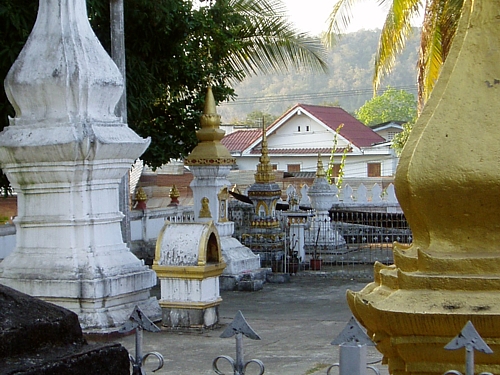
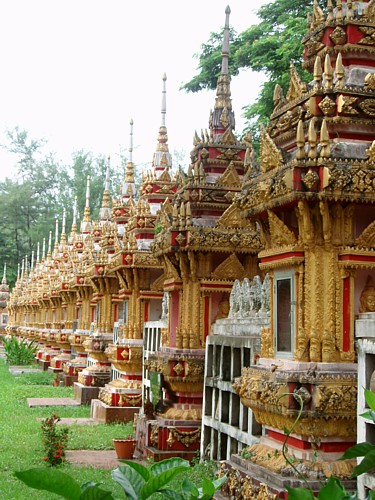
Lao version of columbaria:

PC260037

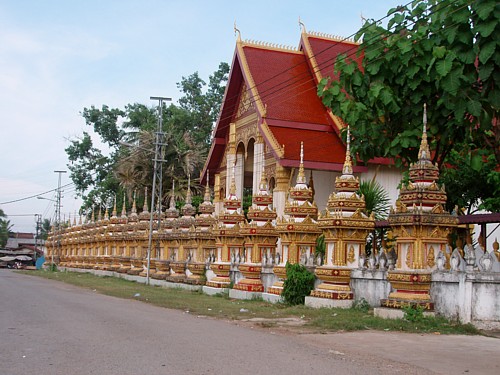
Such mini stupas housing ashes of the deceased are incorporated into the boundary walls of many temples in Vientiane capital, like this (Wat Nongbone) & this (Wat That Luang Tai). Here in Luang Prabang, almost all of them are inside of & separate from the boundary walls.

PC260038
PC260012

Friday, May 02, 2008

261206 Wat Mahathat - banner

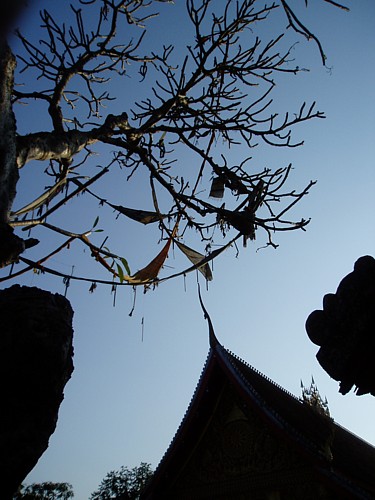
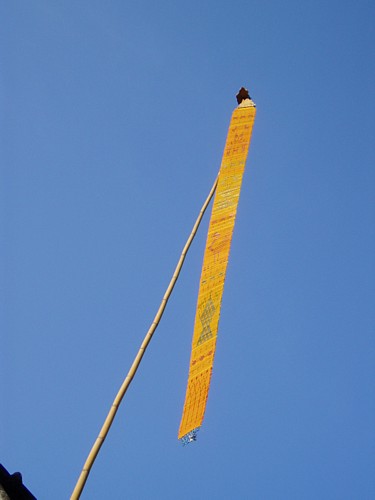
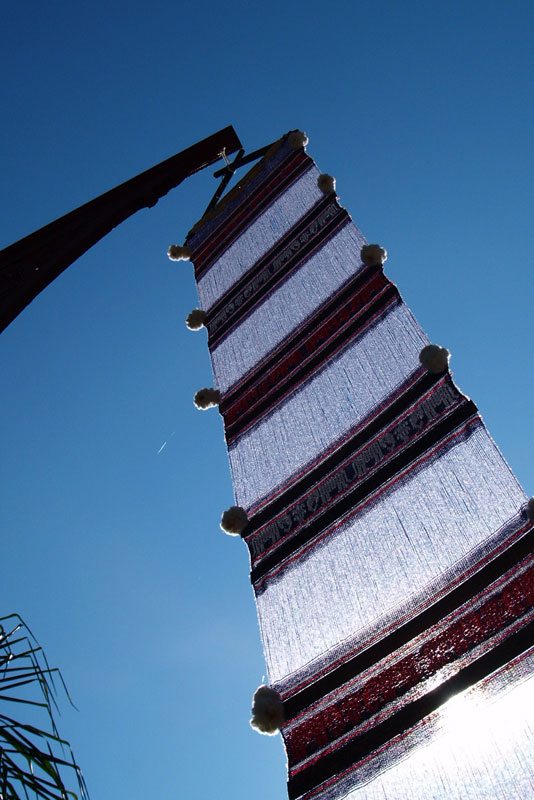
A yellow ທຸງ (thoung, aka. ตุง dtung in Lanna Thai) on the grounds of Wat Mahathat:

PC260019

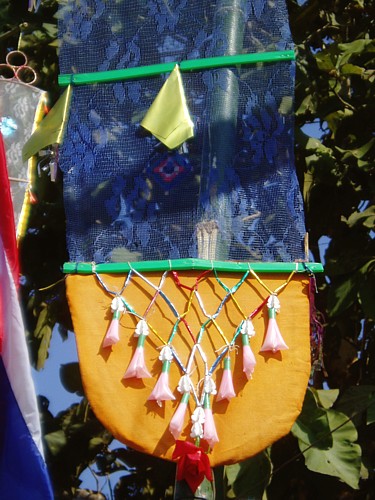
Much like some of those that the cat saw hanging from the ceiling of Wat Sing Jai, a Tai Lue temple in Muang Sing, & at another temple (upper left) in Chiang Khong, & some other places in Chiangrai.

Tai Lue (ไทลื้อ), Tai Yai & some other Tai ethnic groups weave such banners as offerings for the Buddha, to make merit for one's future life, as offerings for ancestors, & on occasions like ordinations, the completion of a new temple building, & funerals. The cat has been told that in parts of North Thailand, red coloured ones are planted at sites of 'dtaai hohng' (ตายโหง unnatural or violent death) e.g. site of fatal accident along a road, to help the deceased to be reborn again. Without them the spirit will remain behind until another victim comes to take his/her place. The cat has not seen such examples before, but imagines that they must be placed like the white wooden crosses it has seen along highways in Australia & other Western countries.

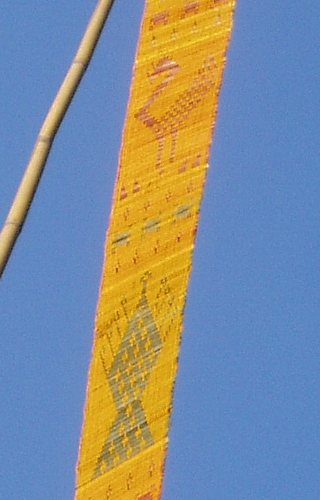
There are motifs like hongsa, elephants, horses, naga, diamond shapes, thaat (stupa), castle-like structures that represent heavenly abodes, structures that look like this, & other stuff that the cat cannot figure out, like this (click to zoom in on amazing detail), this & this:

PC260019a

Thin strips of bamboo are used to stiffen the banners, which are like ladders to help souls of the deceased climb from hell up into heaven. In the laomeow consultants' Tai Lue village, villagers make rockets (a la Boun Bangfai, the rainmaking 'rocket festival') to go with such banners during funerals. Presumably one needs a hole in the sky in order to ascend to heaven?

Traditionally these banners are woven from cotton, & may be decorated with tassels, little pompoms, paper flowers, or even membranaceous winged seeds (from some pterocarp species?) & banknotes tied to them along the fringes. Tai Lue are known for their signature black+red+white versions, a colour combination used for their pha chet luang (shoulder scarf), blankets, bedsheets, coffin covers, shoulder bags, & other textiles as well. Now modern 'shortcut' versions (Tai Yai example from Chiangrai) are made by cutting long strips of cloth or even lace, no weaving required.

Some banners are made with 16 sections to represent the '16 levels of heaven'...think this refers to the 16 'realms of form' (rupaloka), part of the 31 planes of existence in Buddhist cosmology. In some parts of Thailand, a short banner with three 'tails' called thoung saam haang (ตุงสามหาง lit. banner three tails) is used in funeral processions.

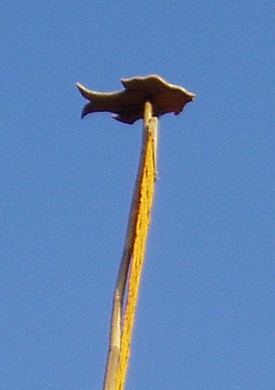
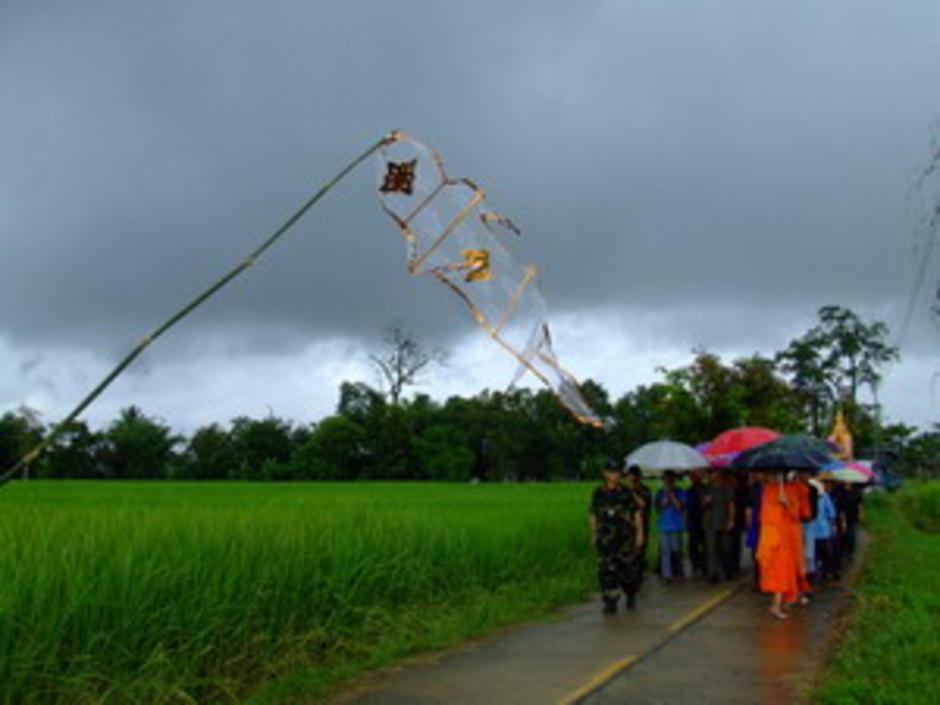
No matter how long a bamboo pole you use, no matter how high you raise it in the sky...what makes you think you can ever hide a fish from a cat?

PC260017

Anyone who knows if the fish at the top of the pole of the banner has any special meaning, please enlighten the cat. Some links for those who would like to find out more about 'thoung' (mostly Thai-only websites):

area.obec.go.th/phayao1/upa/Gong.htm
(TH)
www.stjohn.ac.th/Department/info/tung.html (TH)
lanna.mju.ac.th/lannaequipments_detail.php?recordID=36 (TH)
www.thaitextilemuseum.com/English/Variety/tung.pdf (EN)
Textiles of Southeast Asia: Tradition, Trade & Transformation on Google Books (EN)
cultural.payap.ac.th/story/N8BWra1Sat23057.pdf (TH)

Saturday, April 05, 2008

261206 Wat Mahathat - Pha Phom & the story of Pi Mai Lao

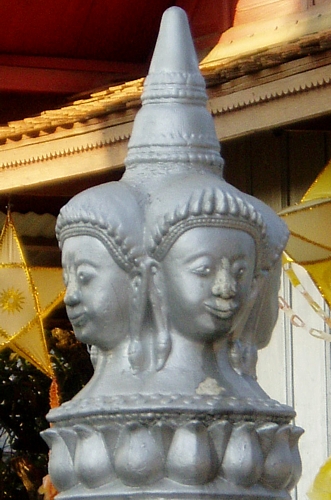
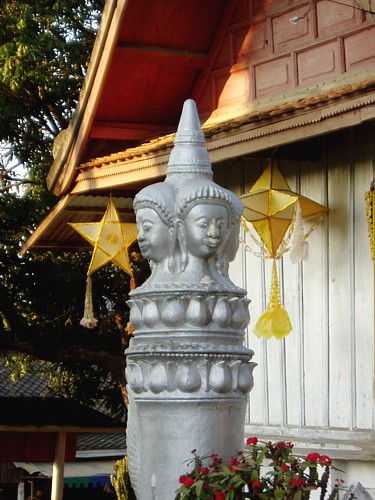
At the top of the steps leading up from Chao Fa Ngum Road, ພະພົມ Pha Phom...

PC260043a

...or พระพรหม Phra Phrom to the Thais, Brahma to the Hindus, 四面佛 (lit. four-faced 'Buddha') to the Chinese, & sii3 ming7 hook8 [1] to the Teochew Chinese.

Long ago, a rich but childless man lived near a drunkard with two children, who insulted him by saying that all his wealth was useless as it couldn't help him & his wife have a child. One day, at a banyan tree beside a river, the rich man prayed for a child at the moment when the sun first entered the sign of Aries. The spirit dwelling within the tree took pity on him, & related his plight to the Pha In (พระอินทร์, Indra), who then ordered a เทพบุตร (male deity) named ธรรมบาล (Dhammabaan) to be born as a son to the rich man & his wife.

The son, named ธรรมบาล กุมาร (Dhammabaan Kumaan - lit. Dhammabaan child), was a genius who understood the language of birds & completed his Traiphet [2] (ไตรเภท) studies by the age of seven. One day, Thao Kabil Phom (ท้าวกบิลพรหม, another name for Pha Phom) challenged the son to answer three riddles [3] within seven days, failing which he would lose his head. If he succeeded, Pha Phom would instead cut off his own head.

Unable to come up with the answers after six days, Dhammaban Kumaan lay under a toddy palm tree, thinking that it was better to die in a secret place than be beheaded. Above him in the tree was an eagles' nest, where a female eagle asked its mate where they would hunt for food the next day. The male eagle replied that they would feed on the corpse of Dhammaban Kumaan, as Pha Phom was going to kill him for not being able to answer the three riddles. It went on to tell the female eagle both the questions & the answers [4], which the boy overheard.

On hearing the correct answers from Dhammaban Kumaan, Pha Phom had to cut off his own head. However, his head would set everything on fire if it touched the ground, cause drought if it touched the air, & dry up the oceans if it touched water. In order to prevent this, he ordered that his head be kept within a cave in Mount Krailaat (เขาไกรลาศ). Once a year, on the day the Sun enters the sign of Aries, it was to be taken out & paraded clockwise around Mount Sumeru on a tray carried by one of his seven daughters. That day would be มหาสงกรานต์ Maha Songkran day, the 13th of April. Each daughter was assigned to a day of the week, & the day on which Maha Songkran fell would determine which daughter would perform the task of carrying her father's head.

To be continued in next post...
  1. Tones follow this Peng'im system
  2. Traiphet, or 'three types of knowledge', refers to three of the four Samhitas, the oldest sacred texts (Vedas, or เวท in Thai) of Hinduism - the Rig Veda (คัมภีร์ฤคเวท), Yajur Veda (คัมภีร์ยชุรเวท) & Sama Veda (คัมภีร์สามเวท).
  3. Where is a person's radiance at dawn? Where is a person's radiance at noon? Where is a person's radiance at dusk?
  4. At dawn, it is at the face, hence people wash their face at dawn. At noon, it is at the chest, hence people spray scented water on their chest at noon. At dusk, it is at the feet, hence people wash their feet before going to bed.

Sunday, March 02, 2008

261206 remnants of Boun Lai Heua Fai

ບຸນໄຫລເຮືອໄຟ (lit. festival float boat fire/light) is celebrated during Ok Phansa at the end of the three-month rains retreat (Buddhist Lent), which usually falls on a full moon day in October. In Luang Prabang, people make lanterns & parade floats which are carried through town in a procession before being launched onto the Mekong & floated downriver towards Ban Wat That.

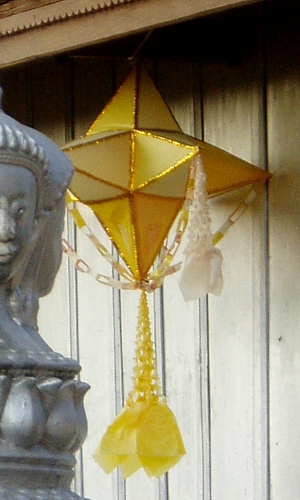
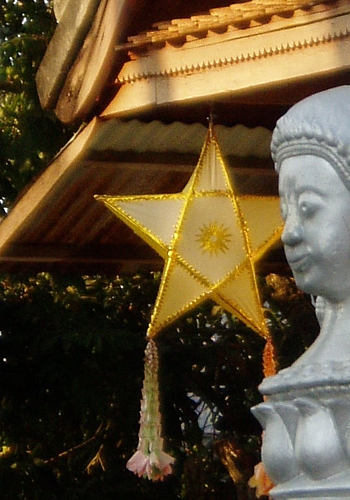
Some of the lantern designs in Luang Prabang are similar to those made in North Thailand for Yi Peng (ยี่เป็ง, also called Deuan Sorng in Kham Meuang คำเมือง or Northern Thai language), the Lanna version of the Thai festival of Loy Krathong. The cat found some leftovers hanging around Wat Mahathat:

PC260043
PC260043c

Khom daao (ໂຄມດາວ lit. lantern star):

PC260043b

There are other types like khom bang (ໂຄມບັ້ງ lit. lantern tube/cylinder), khom kaab (ໂຄມກາບ lit. lantern bowing with palms together in prayer) & khom bpin (ໂຄມປິ່ນ lit. lantern spin). The cat is most fascinated by the latter, known as khom phat (โคมผัด) in North Thailand. It consists of an inner frame with cut-out figures of animals & people that rotates within an outer frame, casting moving shadows (click to see movie).

The lanterns are kinda hard to pack & carry or ship home, or else locals could start making some for sale to tourists =P Apparently they are made only in the upper north, a laomeow consultant who says...

yes, i know how to cut the paper to make the stars...i made the stars by myself. i looked at some monk do it so i can study from them

...was disappointed when he moved to Vientiane & no one there made anything except krathong-type floats when Ok Phansa 2007 came round, making him even more homesick. The cat started making simple Chinese papercuttings (剪纸 jian2 zhi3) like this & this when it was 12 years old...perhaps it should ask him to teach it a few Lanna designs.

This has something to do with the story of Pi Mai Lao (Lao New Year in mid-April):

PC260043a

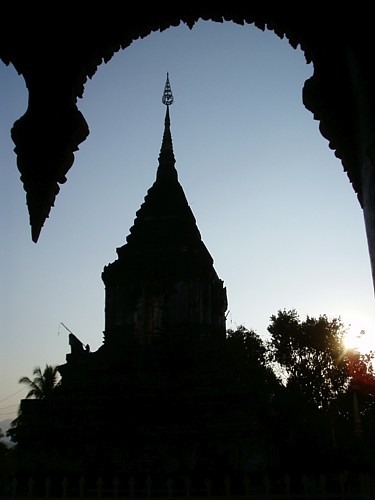
261206 The that that Wat Maha That

...is named after:

PC260049

That (ທາດ) = stupa, chedi (เจดีย์) or chorten, a structure for enshrining sacred relics of the Buddha or remains of highly revered monks or royalty, marking the eight great deeds accomplished during the Buddha's life, or containing Buddha images & amulets (e.g. Wat Klang Wiang, Chiangrai).

Lao-style stupas are described as having the shape of an elongated lotus bud, like this (That Phanom, Nakhon Phanom in Thailand) & this (That Luang, Vientiane). The cat has seen other shapes like this (Wat Sing Jai, Muang Sing), plenty of smooth bell-shaped ones in Bangkok, & this one seems rather squarish like some in North Thailand:
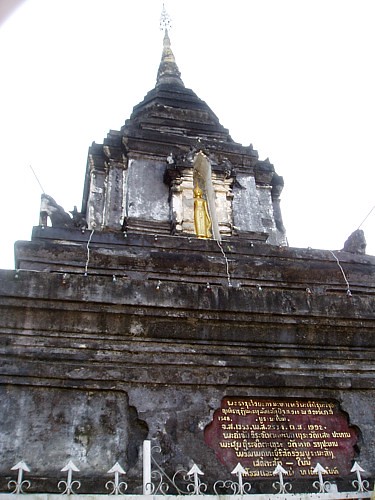
PC260029

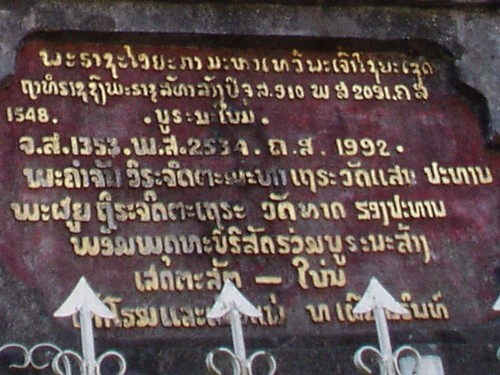
With help from a laomeow consultant & a dictionary...
PC260029a

pharasa ai ya pha Maha Thewi King Saiyaset-
thathirat...built year 910 CS 2091 BE
1548 AD .restore new.
1353 CS 2534 BE 1992 AD
Pha Khamchan Virajitta Mahathera Wat Saen chairman
Pha Phuy Thirajita Thera Wat That vice-chairman
together...combine restore build
... - new
... (blocked by spikes) ...

Maha Thewi (มหาเทวี) is probably Queen Yudhi Karma Devi aka. Yotkamtip, the daughter of Lanna King Ket Klao (พระเมืองเกษเกล้า) from Chiangmai who became the first of five wives of King Photisarat. King Saiyasetthathirat (Sai Setthathilat) is the guy who built two of the most famous tourist sites in Laos - Wat Xieng Thong in Luang Prabang & That Luang in Vientiane (the statue sitting in front of it is that of him). The dates are written in three forms - 'jor sor' (ຈ.ສ. or จุลศักราช) or Chulasakarat (CS, still used in Burma), 'phor sor' (พุทธศักราช) or Buddhasakarat (BE, Buddhist Era, used in Thailand & Laos), & 'khor sor' (คริสต์ศักราช) or Khritsakarat (AD, Christian Era/Anno Domini).

The consultant's translation has it that the 'beaulder' [sic] of this stupa is Maha Thewi...while this source says that the stupa was built by King Photisarat, her father-in-law...& another source (Ancient Luang Prabang by Denise Heywood) says that it was built in honour of her. Then again, some of the terms associated with royalty are kinda alien to the consultant (born 11 years after the Communist takeover of Laos), & the spelling of some words written by older generation Lao do not tally with the 'modernised' spellings that he learnt in school, so translation was not that straightforward.

Venerable Pha Khamchan Virajitta Mahathera (Great Elder) was the abbot of Wat Saen & provincial patriach of the Luang Prabang sangha, who would pass away in July 2007. A former novice monk of Wat Saen (cousin of a cousin of the abovementioned consultant) said that the Elder was most highly respected for devoting 66 years of his life to Buddhism. He was strict, but that former novice is deeply grateful for the discipline & enforced 'study time', which kept him from turning wayward & allowed him to make it to college. Many tourists have photographed the Elder as he led what tour brochures term 'the longest line of monks' during the morning alms round everyday without fail, unless he was too ill or not in town. A few tourists ended up photographing his funeral procession to the cremation ground at Wat That Luang.
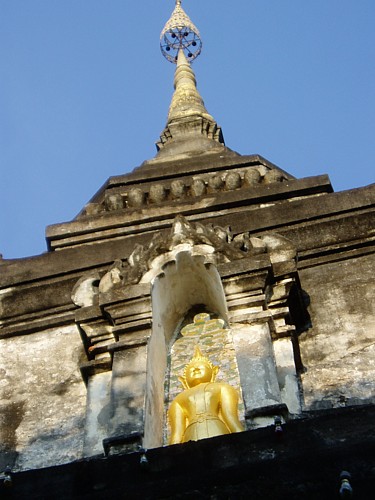
PC260036

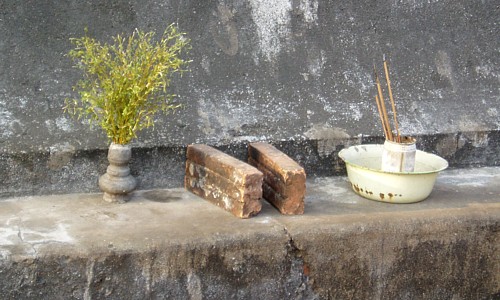
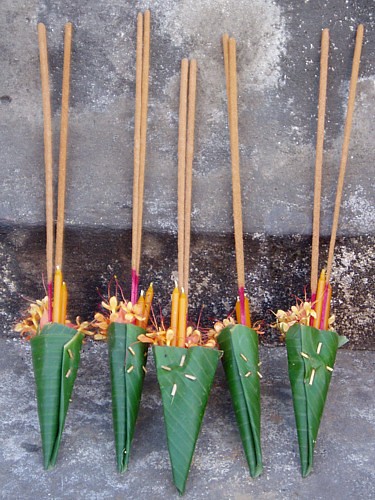
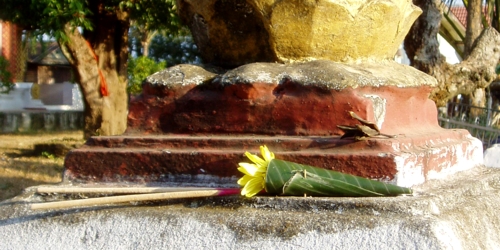
Offerings at the base of the stupa:

PC260031
PC260033

Don't know why the incense sticks are in pairs...Chinese use this number for paying respects to the deceased...
PC260032

Recycling of aluminum drink can:
PC260034

Monday, February 25, 2008

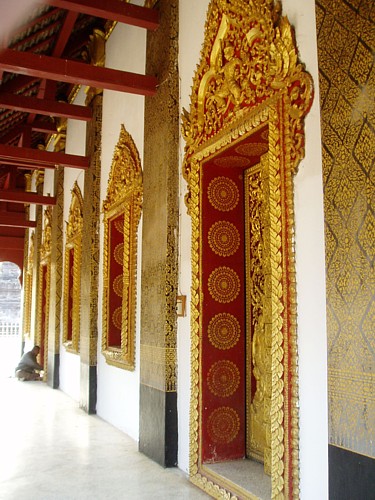
261206 Wat Mahathat - doors & pillars

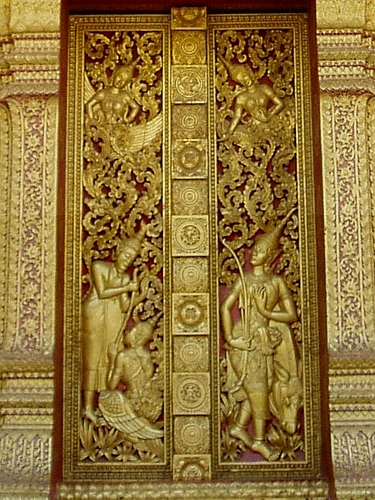
Main door of ສິມ (sim - not sure if congregation/assembly hall is best translation):
PC260024b

Side doors:

PC260072

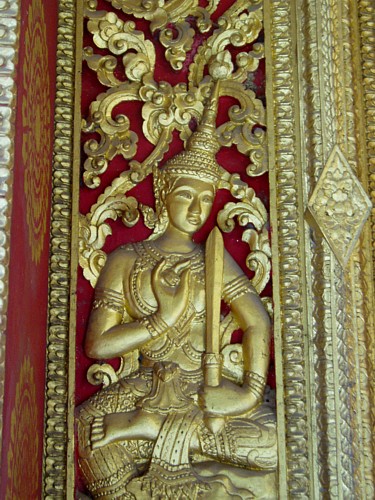
Panel of side door:

PC260056

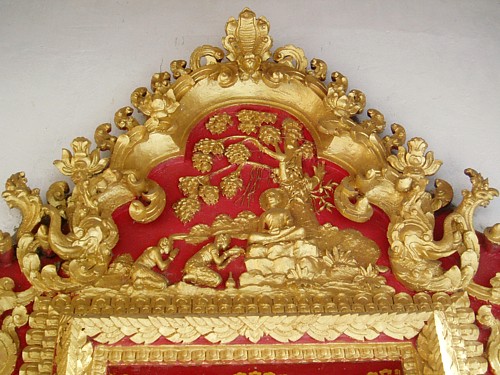
Pediment above side door:

PC260053

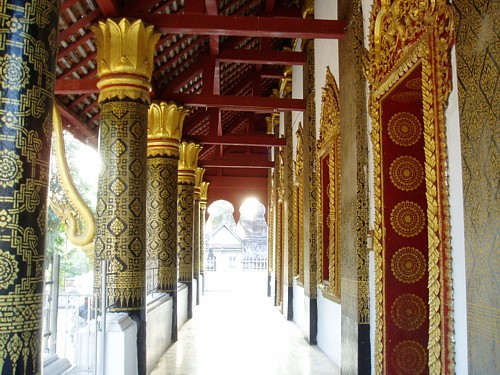
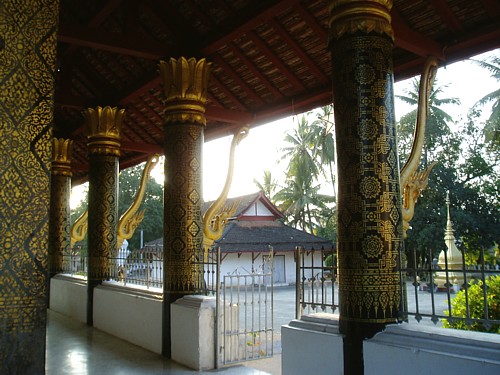
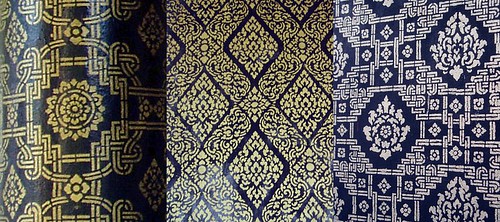
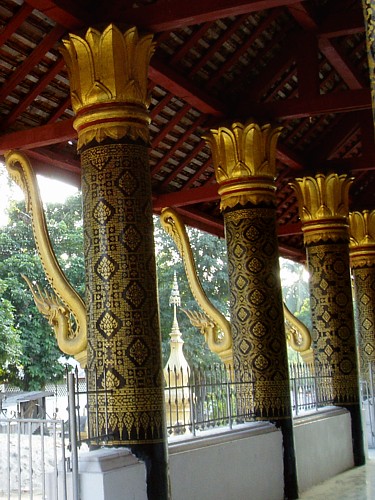
Pillars, with different gold-stencilled designs...

PC260071
PC260067
PC260055-57-68

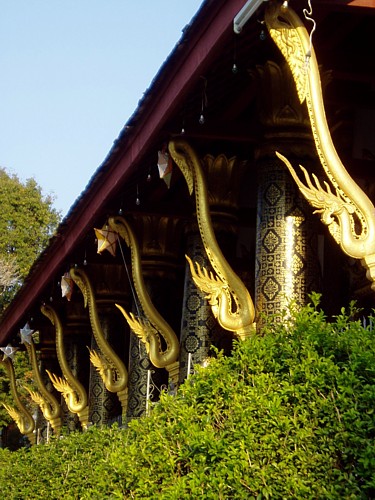
...& naga eave brackets:

PC260068
PC260040

Sunday, February 24, 2008

261206 Wat Mahathat - ceiling & roof

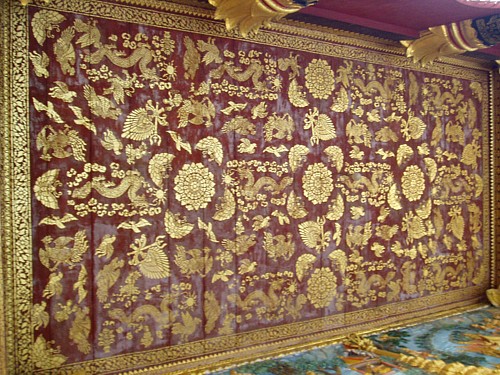
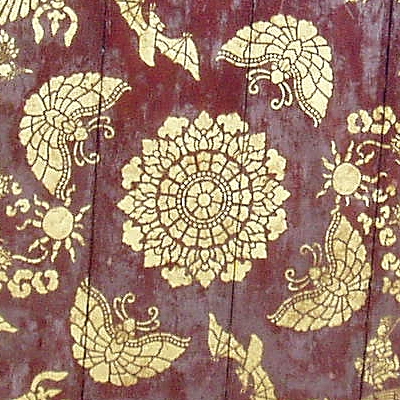
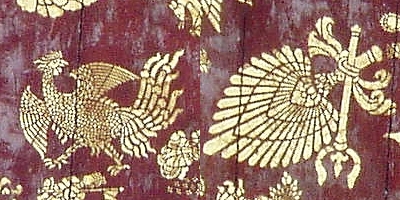
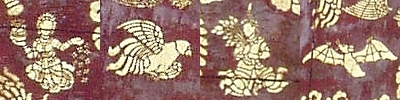
Stencilled with gold paint above the front wall of the congregation hall:

PC260069

Moths or butterflies?

PC260064c

Some kinda bird (left) & no-idea-what (right) - hence no idea which orientation it should have!

PC260064b

Devas, bird & bat:

PC260064e

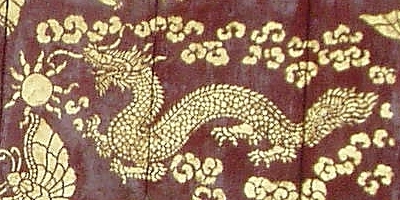
Chinese dragon & a crab-like sun?

PC260064a

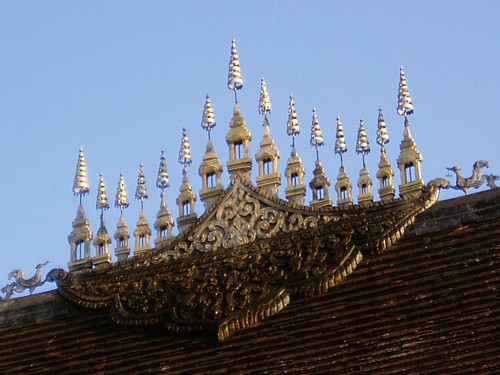
yot sor faa on the ridge of the roof, with a hongsa at either end:

PC260042

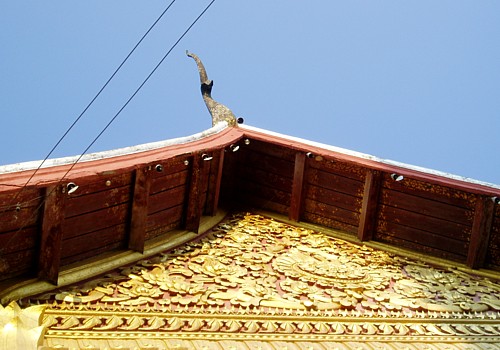
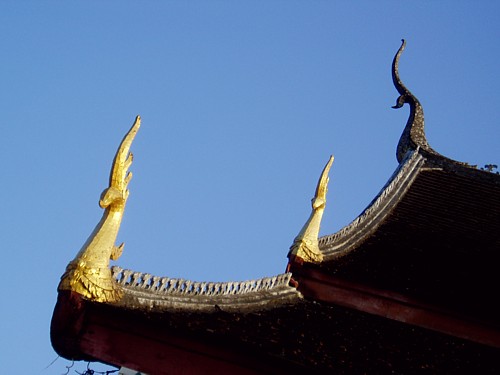
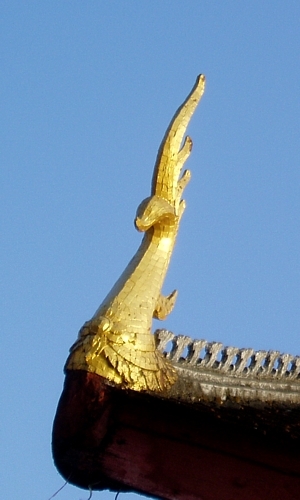
chor faa (roof finial):

PC260054
PC260046
PC260046a

They are installed during a special ceremony as part of the temple building construction process, but now many end up mounted & sold as antiques for display in hotels & homes...

261206 Wat Mahathat - Sithone & Manola

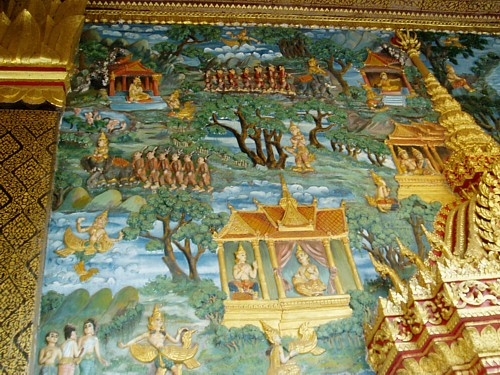
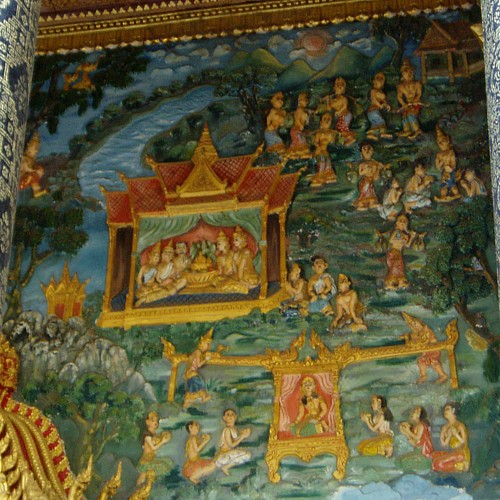
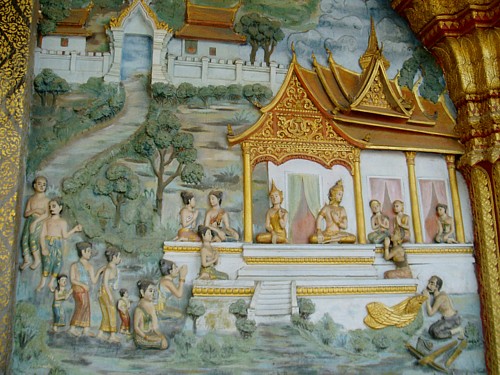
The front wall of the congregation hall is decorated with this sort of 3D art (no idea what the term for it is)...

PC260059
PC260021
PC260058

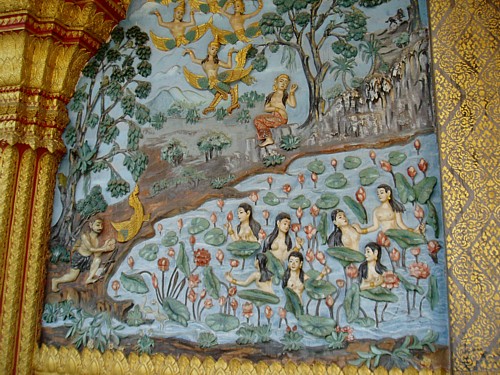
...depicting a story known as Sithone & Manola (aka. Phra Suthon & Manora in Thailand, or Sudhana & Manohara in Indonesia), from the Pannyasa Chadok (ปัญญาสชาดก), a collection of jataka (chadok, or stories of the Buddha's previous lives).

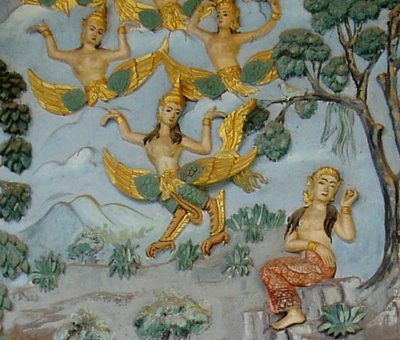
Nang Manola is the kinnaree (half-bird half-human)...

PC260065a

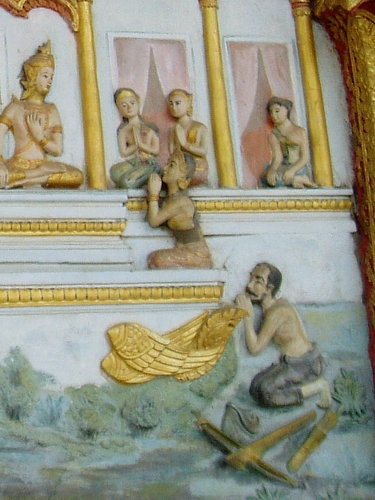
...who left her wings & tail (below, golden things at middle left) aside while bathing in a lake...

PC260065

Unable to fly away, she was caught by a hunter (above, at bottom left), who brought her to the palace...

PC260058b

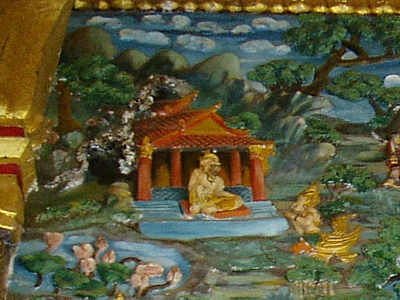
There, Prince Sithone fell in love with her & married her. While he was away at battle, there was a plot to have Manola killed, but she managed to get back her wings from her mother-in-law. To help the prince locate her on his return, Manola left directions with a hermit (reusii/rishi) in the forest...

PC260059a

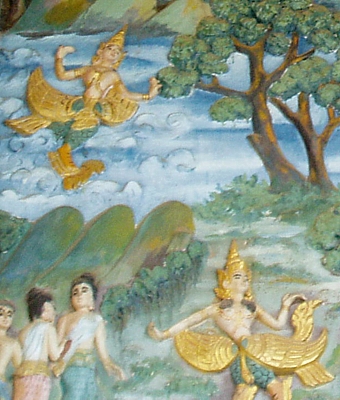
...before flying back to the safety of the kinnara kingdom...

PC260059c

They were eventually reunited after Sithone managed to pass a series of tests set for him by Manola's father, one of which was to identify her from a group of identical-looking kinnaree.

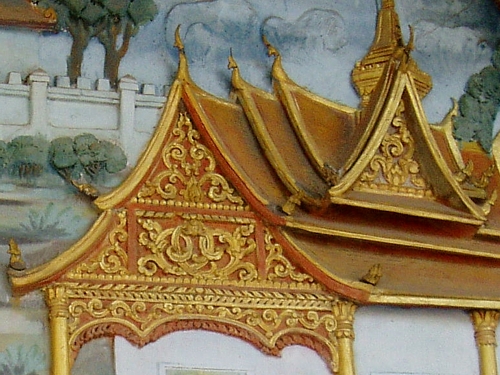
The detail is mind-blowing - right down to the roof finials & gables:

PC260058a

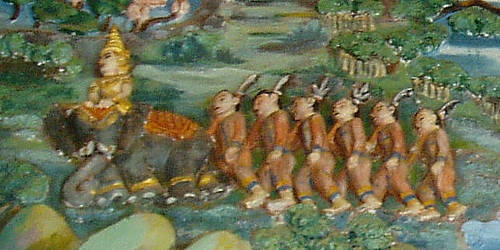
Mini elephant + giant foot soldiers - seriously it isn't that wise to walk so closely behind the elephant pie-producing end of the pachyderm:

PC260059b

At the time of the cat's visit, it wanted to ask around about the story behind this work of art, but everyone was busy:

PC260006

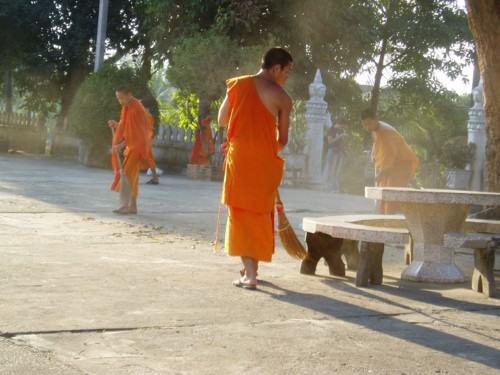
They had to finish this & then bathe, get dressed in full robes, light the candles & set up the congregation hall & then strike the bell to get everyone assembled for the daily evening chanting. More than a year later, the cat finally stumbled upon the story while searching for information on the main stupa of this temple.