Showing posts with label buddhism. Show all posts

Saturday, September 10, 2011

280707 That Luang - 05 parts of that

P7300250
P7300281
P7300251
P7300252

There are 30 of these 'spires' surrounding the actual stupa:

P7300257

Each one represents a parami (บารมี barami - Thai, 波罗蜜 bo1 luo2 mi4 - Chinese), the perfection of a virtue that is part of the path to enlightenment:

P7280056

10 parami - dana (ทาน taan 布施, generosity - from which the practice of giving alms stems), sila (ศีล siin 持戒, virtue - observing the precepts), nekkhamma (เนกขัมมะ renunciation), panna (ปัญญา panya 智慧, wisdom), viriya (วิริยะ wiriya 精進, persistence), khanti (ขันติ 忍辱 patience/tolerance), sacca (สัจจะ satja 真实, truth), adhitthana (อธิษฐาน 決意 determination), metta (เมตตา loving kindness) & upekkha (อุเบกขา ubekkha 和捨, equanimity) - each practised at 3 levels (parami, upaparami & paramattha parami) gives a total of 30 parami. The 30 parami (timsa parami) are sometimes included in the chanting sessions at Theravada temples.

There are jatakas (stories of the past lives of the Buddha) that describe each of the 10 parami, & the marathon recitation of the Vessantara jataka (Maha Wetsandon chadok, about the generosity of Prince Vessantara) is the focus of the Boun Pha Wet festival in Laos & Isaan. The Pali words for the various parami feature in the 'ordained'/Pali names of many Theravada monks & nuns, & likewise some of the Chinese words in the ordained names of Chinese Mahayana monks & nuns. For laypeople, the Chinese words for the parami of panna & metta also appear as part of some Chinese first names, while a few of the Lao/Thai terms for the parami are popular in both first & family names - in particular 'khanti' for Lao people (e.g. Khantisouk), which is pretty apt given the amount of waiting that is involved in getting things done in Laos :P

Useless trivia - 波罗蜜 the Chinese term for parami sounds exactly like & is written almost exactly like 菠萝蜜 the Chinese word for jackfruit :P & it so happens that Theravada monks of the Thai forest tradition traditionally dyed their robes brown using the heartwood of jackfruit trees.

P7300263
P7300258
P7300260
P7300284
P7300259

Sunday, January 16, 2011

071209 Wat Had Siaw 6 - meditation corridor

An interruption to normal programming - a 'special feature' series of posts on Wat Had Siaw in Chomphet district of Luang Prabang. Please see part 1 of this series for background info on this place & the reason for this 'special feature'.


Facing the viharn is the long narrow building for the practice of walking meditation:

PC070059

Apparently only 4 temples in Luang Prabang have such a structure, & 3 of them are on this side of the Mekong (the other two being Wat Long Khoun & Wat Khok Phab). The cat has yet to come across any mention of similar structures in temples elsewhere - do they now exist only in Luang Prabang?

Like the viharn, this structure is also crumbling - parts of the roof are gone:

PC070054
PC070055

Instead of windows, it has only small openings along its length for ventilation, & a single door in the middle:

PC070053

The floor of the interior was littered with bits & pieces of the roof & plaster that had cracked off the walls:

PC070056

The wall facing the viharn is keeling over:

PC070057
PC070058

071209 Wat Had Siaw 3 - exterior murals

An interruption to normal programming - a 'special feature' series of posts on Wat Had Siaw in Chomphet district of Luang Prabang. Please see part 1 of this series for background info on this place & the reason for this 'special feature'.


Above main entrance door of viharn - scenes from Buddha's life story:

PC070049

The Earth Mother/Goddess deity แม่ธรณี Mae Thoranii wrings water from her hair (left half) to drown Mara & other demons attacking Buddha (right half):

PC070049b

Beware of what's lurking in the flood created by Mae Thoranii - victim #1 has his head chomped on by shark-like creature #1, while all that's left of victim #2 are 2 legs sticking out from the jaws of shark-like creature #2:

PC070049c

Prince Siddartha leaves home & cut off his hair by the banks of the Anoma river to become a mendicant:

PC070049f

On his right are his servant Chana & horse Kanthanka. At bottom right, after eating, he floats a bowl in the river & it travels upstream against the current, indicating that he will gain enlightenment in time to come. The bowl contained an offering of milk rice given to him by a noble lady called Sujatha.

Scenes that the cat has never come across before:

PC070049e

At the top, a god(?) appears to be playing a musical instrument while Buddha rests below some trees, & at left, Buddha looks up at a stupa...?

When he finally attains Enlightenment he is depicted as sitting on a lotus flower (middle):

PC070049d

Below the above paintings, flanking the main door:

PC070048
PC070050

Sunday, January 17, 2010

291206 evening chanting

Every morning & evening, at Buddhist monasteries across the world, members of the sangha gather to chant. Traditions (1), schools (2) & 'sects' (3) may vary, the suttas (sutras) chanted may differ, & even the same suttas may be chanted in different languages (4), but everyone is linked by the same Buddha, Triple Gem & Four Noble Truths.

Theravada temples in Thailand & Laos, as well as Thai (not sure about the Sri Lankan & Burmese) Theravada temples in Singapore usually start off with the same passages:
The youtube videos linked above have Chinese, Thai & romanised Pali subtitles, while the text link has Thai script & romanised Pali accompanied by English translations.

In addition to those listed above, other passages may be chanted too. Choice of these additional passages may differ from temple to temple, & from day to day within the same temple. In the second video linked above, 'reflections on sharing blessings' (3:32-5:36 / last section of this site) & the 'five subjects for frequent recollection' (5:47-7:19 / text) are chanted at the end. Some temples that the cat has been to include a short period of sitting meditation in between.

Some temples in Singapore & Bangkok have several copies of chanting books lying around the sim for any interested lay people to pick up & follow/join in the chanting. In the Mahayana tradition (dominant in Singapore), chanting is something that lay people participate in together with monks & nuns, & there are 'mass chanting/recitation' events held as part of celebrations for festivals such as Vesak. In Malaysia, Taiwan & Singapore, it is not unusual for people to listen to CDs of musical versions of the more well-known Mahayana chants e.g. 大悲咒 da4 bei1 zhou4 (Great compassion mantra) & 心经 xin1 jing1 (Heart sutra), & even display the mantra 南无阿弥陀佛 Namo Amitabha on the rear windshield of vehicles.

While monks at the Sri Lankan Theravada temple in Singapore also lead lay people in chanting from texts on Buddhist 'holy' days, in Thailand & Laos (where Theravada dominates) chanting seems to be more of something that lay people invite monks to do on their behalf. Perhaps that is why in Laos, the only chanting books the cat has seen all belonged to novice monks, & to date the only local lay people it has seen at evening chanting were two consultants (one a former monk), when a third consultant invited the 3 of us to listen to him lead the chanting in his temple in 2009.

Evening chanting in Wat Chan, Vientiane (photo from 2007 trip):

P8020501

Full monks at the front, novices behind them, & laymen & cats at the back with full view of what certain 'more monk-ey than monk' novices do behind the backs of the monks - texting/chatting on mobile phones, throwing chanting books at/poking/hitting their friends, trying to push one another over, etc...boys will be boys ;)

Depending on the temple, attendance may (not always) be compulsory. Some older monks may chose to chant at the altar in their own living quarters, especially if they have mobility problems. The cat has also sat through 'roll calls' at the end of evening chanting sessions where attendance is checked. In a consultant's Vientiane temple, everyone will be given extra chores to do should anyone be absent more than thrice during phansa (rains retreat). On the other hand, the cat has also been to a large Thai temple during phansa where only a few of the oldest (except the wheelchair-bound abbot) monks & zero novices turned up...

On its last evening in Luang Prabang, the cat finally figured out why temple chanting in Laos sounds different from what it is used to hearing elsewhere - the majority of the voices are the higher pitched ones of young novices, as compared to the deeper ones of older monks in Singapore & Thailand. At this particular temple, chanting was 'fast-forwarded', led by Monk B at breakneck speed - the fastest the cat has ever heard anywhere. All 'triple bows' were similarly accelerated (!!) & everything was over in 30 minutes flat, while the monks & novices in Wat Next Door continued to drone on long after the sun had set. Things have since slowed down after Monk B left in 2008, & Monk A & Monk B's younger brother now lead at a less breathless pace :P


  1. Mahayana, Theravada, Vajrayana
  2. 淨土宗 Jingtuzong aka. Pureland, 禅 Zen aka. Chan, Tibetan, etc
  3. มหานิกาย Maha-nikaya, ธรรมยุตนิกาย Dhammayut-nikaya, etc
  4. e.g. Japanese [ho] or Chinese [fa] pronounciation of the Chinese translation of Sanskrit [dharma], Sinhala or Khmer or Burmese translations of Pali, etc

Saturday, August 15, 2009

291206 出家-想家

05. khit theung baan

Those left behind:

1 2 3

A new identity:

4 5

Concrete feels so different from rice straw:

6

Most of the teachers left home to ordain around the age of 13-15, in order to further their education beyond primary school. Some like Monk TYF & 3-day old monk stepped into school for the first time only at age 9-11. While Monk TYF's parents were supportive, packing him off to a larger village in a neighbouring province so that he could continue on to lower secondary school, 3-day old monk was under constant family pressure to drop out from the time he was 10 y/o, just like the cat's dad. Every pair of hands was needed in the fields, & one doesn't need to go to school in order to learn how to plant rice, maize or sesame. Cash for uniforms & books was (& still is) hard to come by. Even if their parents sold off part of their harvest or livestock, most of the earnings would be eaten up by the cost of travel to & from the nearest market, & the family would have less reserves of rice to see them through should the next harvest be poor. Back then, around the mid-90s, less than 20% of Lao children completed primary education, with another ~20% receiving no education at all.

Others like Novice Spoil Market & Monk Big Head (that's what his name means in Hokkien & Teochew :P) started their 5 years of primary education at age 7, then dropped out of the education system for 2-3 years. There was no secondary school within walking distance of their villages. Monk V had a bicycle, but once it had been worn beyond repair by Lao roads, making the 16KM roundtrip on foot was just too tiring.

In addition, quite a few of them finished Por. 5 (5th & final year of primary school) around the time the 1997 Asian Financial Crisis struck. Inflation hit 87% in 1998 & 134% in 1999. Some families found themselves no longer able to feed all mouths, & sons were sent to live in temples to lighten their parents' burden.

One father moved his family from the mountains (3 hours climb down to the nearest secondary school) to a lowland town in 1997 in order for his kids to have better access to education. Their attempt at starting a new life in town doomed by bad timing, the family retreated back to subsistence agriculture in the highlands. Nevertheless, they found an alternate path to their goal - sending two sons to become novices in a town temple. Quite a few families from traditionally animist ethnic groups have chosen this option, & there are now Khmu, Hmong & (more rarely) Akha novices. For those who had known only life within their isolated villages, had never stepped into a Buddhist temple before, & couldn't speak Lao, the experience was akin to being sent to Mars and being made to dress Martian (little orange instead of green men), speak, chant & write Martian & do other Martian stuff. For some, the journey to their new life was their first time seeing 'black' (paved) roads.

Some had no advance warning e.g. One day somebody from my village took me to go with him & when we arrived XXX town he took me to be novice, or a parent handing them just enough cash for the boat journey to XXX town & telling them to leave & find a temple there. Others saw it coming - it was a matter of time before they finished primary school & were sent to join an older brother or cousin, or it was the usual thing that happened to many boys when their parents died or divorced & relatives couldn't take them in.

In short, practically all of the teachers ended up in temples by circumstance rather than by choice, & the town temples together with the monastic schools end up serving as a boarding school system for rural boys (not unlike Thailand). The merit that they make for their parents by ordaining is just a bonus. As each successive cohort of monk & novice students graduate from the monastic high schools & waste no time returning to lay life & dreams of jeans & motorbikes, they are quickly replaced by a new crop of boys from the villages.

KHIT THEUNGGG!! ex-novice Reebok cap roared in response to the question khit theung baan bor (miss home or not?), hence the title of this post. 出家 chu1 jia1 (lit. exit home) & 想家 xiang3 jia1 (lit. think home) are the Chinese terms for becoming a monk & for missing home respectively.

With the rising prosperity of the more fortunate in the towns & the concomitant increase in the amounts they give as alms, more of the teachers are able to save enough to travel home to visit their families. In the past, quite a few wouldn't see them again for as long as 5-8 years after leaving, now many are able to make the trip home every 1-2 years.

Some like 3-day old monk have no phor mae (parents) left to khit theung (miss), but still look forward to such visits to see their siblings & other relatives, catch up with childhood friends, & enjoy a brief respite from urban life. But there are some who don't care much for home, like one particularly bitter novice who never wants to see his mother or stepfather again - somehow it seems rather common for kids from previous marriages to be 'cast off' when divorced parents remarry (another similarity between Lao & Thai society?). When parents walk out, some sons take a direct route to the temples, others take an indirect route (left to grandparents, & then end up in temples when the grandparents eventually pass away), & the cat would later meet one boy taken in by an expat falang.

Unlike the owners of the first three photos, quite a few who move from the sonnabot (countryside) to live/study/work in urban areas have no photos of their families, & likewise their families have no photos of the kids whom they will hardly get to see for years. When giving its teachers photos of themselves, the cat passes them two copies so that they can send one to their parents back home. Wonder if any of the monk-stalking photographers juggling assorted lenses, tripods, memory cards & other accessories while staking out the monk-shooting hotspots of Luang Prabang might be interested in doing the same? Or are their photos meant only for professional portfolios, Lightstalkers/TrekEarth/Zenfolio/Pbase/Picasa/Flickr, & commercial purposes?

Monday, April 20, 2009

291206 wat fashion?

04. monk fashion vs. novice fashion

During this trip & subsequent trips to Laos, the cat encountered many questions about monks' robes. On discovering that it was Buddhist, Western tourists usually quizzed it about the Theravada tradition - stuff like why Burmese monks wear maroon but Lao monks wear orange & some Thai monks wear ขนุน (khanun aka. jackfruit - dull brown dye from the wood of the jackfruit tree). The most popular question from Laotians - on discovering that Mahayana is the dominant tradition in Singapore - was (& still is), how the heck do Mahayana monks practise kungfu in their robes?? Thanks to the Hong Kong film industry & TVB drama serials, in the minds of many Laotians & Thais, Mahayana = Shaolin...!

During the discussion on clot, clots & clotting, ex-novice Reebok cap jumped up, grabbed an outer robe lying near us, & started folding away as all of us stared in shock...laymen aren't supposed to fool around with robes like that...'NOVICE FASHION!' he proudly declared as he draped his handiwork around his T-shirt & bermudas...& then unravelled everything & started wrapping, twisting & rolling...You know how? an incredulous Monk TYF asked, knowing that his village-mate had never been a full monk before...'I see monk do before many time...MONK FASHION!' he declared, as the rest fell over laughing at his half-baked efforts & the cat fell over laughing at his use of the word 'fashion' :P The final verdict on Reebok cap's attempt...

cat: What do you think? Pass or fail?
Monk TYF: FAIL!

Anyway, the cat learnt something new - that in Laos, monks & novices wear their outer robes differently i.e. 'style' depends on 'status'. This makes it easy to distinguish between them, unlike in Thailand, where 'style' depends on the occasion & one's role in it, & things can be more confusing.

In both countries, Theravada monks dress in what Reebok cap termed 'monk fashion' for chanting sessions within the temple, & also when leaving the temple to go on alms round. But during ordination ceremonies, while all other monks turn up in 'monk fashion', the person being ordained is robed in what Reebok cap described as 'novice fashion', even if he is being ordained as a 227-precept monk rather than a 10-precept novice. 'Novice fashion' is also more practical for monks practising vipassana meditation, as it is less likely to unravel.

In other situations, while monks & novices in Laos have to stick to their respective 'fashions', their Thai counterparts can wear their outer robes either way, depending on personal preference or individual temple/school protocol. Monk TYF had to get used to dressing in the 'novice fashion' of his younger days again when he moved to Thailand & was instructed to turn up for all university exams in that 'style'.

For some reason, quite a few Westerners get the impression that the various shades of saffron/maroon/orange robe cloth correspond with seniority...in actual fact it's a matter of tradition in some situations (in Thailand, Dhammayut monks stick to khanun), while in most instances, it's simply a matter of personal choice (from whatever laymen have donated). Two years later when Monk V pointed at his entire wardrobe in his kuti & commented that having a set each of contrasting shades makes it more obvious that he is a 'hygienic monk' who changes his robes daily, the cat laughed out loud as all the questions on colour that Westerners had asked it before came to mind.

Other 'wat fashion' questions the cat has been asked to answer/translate for monks to answer include:

Why do they carry umbrellas when it isn't raining?
Tropical sun burns shaven scalps.

Why are they allowed to carry only black or brown umbrellas?
Just the two most common colours that laymen donate to them. Black is preferred - transmits less sunlight from above & reflects less heat & glare from the ground. But they have to accept whatever is given, which can result in situations like this. Once the cat had to suppress a laughing fit when a monk friend carried an umbrella with the large logo of the skincare product brand OLAY emblazoned on it.

& probably the most hilarious...

Do novices end up with darker/sunburnt right shoulders?
Most are already quite tan to begin with, & don't burn as easily as fair-skinned Caucasians, but it does happen to a few. Beneath all the colours & robes, everyone is just human :)

Monday, March 09, 2009

291206 orange clots

03. clot, clots & clotting

The teachers started pointing at all sorts of stuff & quizzing the cat on the English terms for each object. When it came to the naga carvings...

Monk TYF: This?
cat: Naga (as pronounced in Lao/Thai)
Monk TYF: Naga? You sure? N-A-G-A?
cat: Yes
Monk TYF: Have tourist tell me that correct way for N-A-G-A is pronounced 'na-jar'
cat: ...

For the record, the 'G' in 'naga' is pronounced like the 'G's in 'golden goose'.

After they ran out of things around us to point at, they started taking out all sorts of stuff & quizzing the cat on the English terms for each item. & then they picked up someone's jiworn (outer robe) lying near us...leading to a struggle over 'cloth', 'clothes' & 'clothing', which quite a few Lao & Thai tend to pronounce as 'clot', 'clots' & 'clotting' respectively...

Bedsheet-sized saffron 'clots':

PA140416

Made by sewing together panels of 'clot' in five columns of staggered rectangles - identical to the layout of rice fields in Magadha, India. During Buddha's time, both Buddhist & non-Buddhist mendicants in India made their robes from bits of discarded cloth (pāmsūda aka. pāmsūla e.g. cloth that had been worn by the dead/burial shrouds, munched by oxen, burnt by fire, gnawed by mice, etc) scavenged from places like cremation grounds & trash heaps.

There was no standard pattern for piecing the scraps together. This confused King Bimbasara, who wanted to dismount to pay his respects to any Buddhist monk he met along his way - how was he to distinguish them from mendicants of other traditions from afar? A request for uniformity was put to Buddha, who then asked Ananda to come up with a standard design that has lasted till today...the same pattern is used for the outer robes worn by Chinese monks in the Mahayana tradition, but with bright red cloth & the pattern outlined in gold:

P8280265
Buddha Tooth Relic Temple, Singapore

The teachers were pretty shocked to hear that devout Chinese Mahayana Buddhist laypeople do wear robes (e.g. at left in above photo) for chanting sessions & ceremonies within temples - black ones called 海青 (hai3 qing1) & dark brown outer robes called 缦衣 (man4 yi1)...Another detail in that photo that would shock them was how laypeople (including women) could stand with their heads higher than those of monks.

Myriad uses of old 'clots':

jiwon2
Photos from 2007 & 2008 in Vientiane & Sakon Nakhon

Clockwise from upper left - to protect Holy 'kidnap victim' from construction dust; to partition off a sleeping area for two very young novices, & hide their Doraemon from the old chief monk of the province who shares the same living quarters; cord belt to keep unruly bamboo stems in place; bedding for temple cat.

Sunday, February 01, 2009

291206 reading as an ability...& writing as a disability

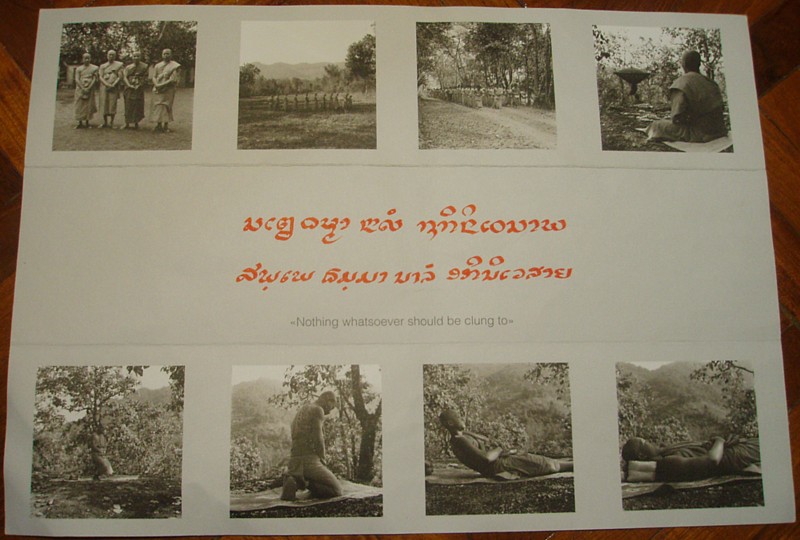
On the reverse side of the exhibition pamphlet:

PC250380
Click here for larger version

At first glance the cat thought that both lines of characters in red were Pali words written using Tham script. Later it realised that the writing in the second line looked a lot more like the modern Lao alphabet than the Lanna alphabet...When the cat's Lao teachers saw the leaflet among the cat's belongings, they pounced upon it with an enthusiasm not seen when faced with their high school Pali homework. They translated the first line as sabbe dhamma nalam abhinivesaya, & the second line as the same Pali words transliterated into Lao as sapphe thammaa naalam aakiniwesaay.

The significance of the quote:

As to what is the heart of Buddhist Teachings, I would like to suggest the short saying, "Nothing whatsoever should be clung to". There is a section in the Majjhima Nikaya where someone approached the Buddha and asked him whether he could summarize his teachings in one phrase and, if he could, what it would be. The Buddha replied that he could: "Sabbe dhamma nalam abhinivesaya". "Sabbe dhamma" means "all things", "nalam" means "should not be", "abhinivesaya" means "to be clung to". Nothing whatsoever should be clung to. Then the Buddha emphasized this point by saying that whoever had heard this core-phrase had heard all the Teachings, who ever put it into practice had practiced all the Teachings, and whoever had received the fruits of practicing this point had received all of the fruits of the Buddhist Teachings.

- from Essential points of the Buddhist teachings by Ajan Buddhadasa (1906-1993)

In the above photo, one minute difference between the second line & 'layman Lao' lies in how the short vowel 'a' is written like a dot beneath the consonant. The only other time the cat has ever seen this is when the Pali names of monks are written in Thai script on transcripts of exam results from Thai Buddhist universities. Another difference is the use of consonants discarded from the modern Lao alphabet (first character of the second word), & also nonextant spelling rules ('aa' in the last word represented by only the letter 'or' - in modern Lao it would be fully spelt out as 'or-aa'). Many of such anachronisms are still retained in modern Thai writing, which makes it much harder to learn to write than Lao. Brings back memories of frequent exclamations by Ajan Titima (author of this great Thai writing workbook) that Thai is a 13th century language! :P

The cat is never the least bit surprised by Thai news reports on how poorly Thai students (especially those in rural schools) fare at writing their own language. Sometimes it wonders if the insistence at clinging onto all the archaic minutiae of their writing system is influenced by a desire to restrict full literacy to a (privileged) highly educated elite...this, in contrast to the efforts of China & Laos to simplify their written languages. Interesting how both the latter are communist....(Although the evolution of simplified Chinese characters predates communism in China, it traces its roots back to the anti-imperialist 五四运动 May Fourth movement.)

The cat is all for the preservation of ancient scripts for historical & cultural reasons, but it believes that literacy for the 'masses' (for want of a better term) is just as important. Quite a few times it has encountered Lao & Thai people unable to make sense of dosage instructions & warnings of side effects & contraindications on medicines (let alone tell apart real from fake medicines, a growing problem in Laos), & warning labels on pesticides & flammables. & getting lost within hospitals, government office complexes & bus stations. & misinterpreting public education posters on nutrition (food pyramid = make pyramid-shaped cabinets for storing food...?), hygiene, parasites, avian influenza, SARS, family planning, human trafficking, land rights, etc.

The list goes on - people not being able to pass driving tests in order to obtain certain types of jobs (though even if they could, red tape & demands for bribes would still stand in the way), nor read statements/reports that police force them to sign. & that family from Kasi district telling a gaggle of tuktuk drivers at Vientiane northern bus station that they need to go to wherever's stated in some official letter that they can't read, & that gaggle of tuktuk drivers having to turn to a bus station staff for help in reading that official letter that they themselves couldn't figure out (destination unknown turned out to be Mahosot Hospital). & people asking the cat if they've boarded the correct bus despite large signboards indicating the destination. & which toilet is the Ladies or Gents even when 'nying' & 'saai' are painted in huge Lao letters outside...

Lao asking non-Lao for help in reading Lao - not too much of a surprise, given the literacy rate, plus how the standard Lao taught in schools is technically a second language for almost half of the citizens, for whom Khmu, Lue, Phouan, Phou Noi, Hmong, Ta Oy, Lanten, Akha, Phoutai, Yao/Mien, Alak, Lahu or some other non-Lao tongue is their first language. The ignorant cat used to wonder why Lao Studies is a compulsory subject for all college & university freshmen in Laos. After all, 'home students' who've cleared their GCE A levels don't have to take compulsory classes in English grammar at UK universities, nor do 'non-international' students in US universities. & then it had a Tai Lue consultant scoring D for Lao Studies due to difficulties with Lao grammar despite having been through 11 years of the Lao education system, & the ethnic & linguistic diversity of the country hit home...a strangely & incredibly familiar situation for the cat, who struggled through 14 years of learning the Mandarin Chinese dialect of Beijing that the ruling party declares to be its 'mother tongue'.

Interesting how not a single family member from its grandparents' generation or older ever knew how to speak Mandarin Chinese, & how those from its parents' generation picked it up only in adulthood. Singapore must be one of the few places on earth where one's 'mother tongue' is officially assigned based on one's officially assigned ethnic classification - regardless of whether anyone in the family can actually speak that language - & where the majority of the citizens study their officially assigned 'mother tongue' as a second language.

Even in Singapore (95.7% literacy), the cat meets people (usually elderly, & including some relatives) caught in some of the situations described above. Over time, the cat realised that when villagers said that it was brave for a girl to travel alone in their countries, safety wasn't the only issue behind that comment. Finding one's way through the bewildering world of the written word littered with signboards, documents, newspapers, timetables, instruction manuals, etc is something many take for granted. Still, in a world where literacy is a key yardstick of achievement & advancement, let us not forget this:

...this [Khmu] visitor [Damrong Tayanin] once delivered a powerful defense of illiteracy, the final message of which was that he pitied the literate who could not remember whatever had not been written down; whose stories were always the same (read from written texts), only as innovative or original as the original author had been; & so forth.

...We need to remember that not all ideas are written down in words...We need to shed our preconceptions...Societies that may be silent in written words are not necessarily stupid or simple.


- from Reading Thai Murals by David K. Wyatt (1937-2006)

After all, how many of us can name every single one of our direct male ancestors like Akha men, or recount our history (including every single village our direct ancestors have ever migrated through) like the pima of Akha villages in Burma, Thailand, Laos & China, & the griots of West Africa, or recall an entire pharmacopeia like Akha & Lahu herbalists, without having to refer to books & documents? What have we lost in gaining the ability to write?

291206 whatever floats your meditation boat

Back to the Royal Palace Museum to finish up the rest of The Quiet in the Land, the exhibition that the cat had stumbled upon the previous day...

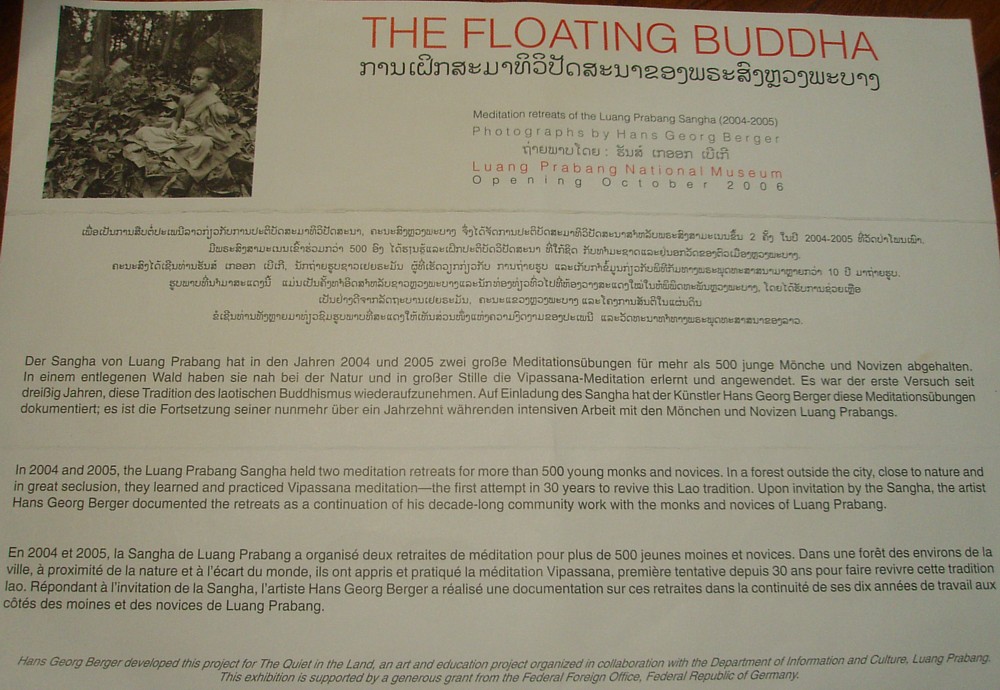
Two of the works touched upon the practice of vipassana meditation - Hans Georg Berger's The Floating Buddha, & Ann Hamilton's The Story of the Meditation Boat. The former is a photographic documentation of the first two vipassana meditation training retreats of the Luang Prabang sangha, held in 2004 & 2005 at Wat Pa Phon Phao. At present such training retreats continue to be held there during the cold season for monks & novices in their final year of high school, where they are taught how to meditate in the four postures - sitting, standing, walking & lying down. Over in Vientiane capital, such training retreats are held at Wat Dongsavath for monk & novice students of the Sangha College, while vipassana lessons open to tourists are at Wat Sok Pa Luang, & an intrepid few have found their way to Wat Nakhoun Noi (contact info).

Most of the students grew up in rural villages, & by all accounts enjoy the forest setting of the retreats at Wat Pa Phon Phao, an interesting break from the four walls of their classrooms. Walking barefooted along the trails is exactly what they did as kids, although shooting birds with catapults & digging up mushrooms & bamboo shoots for dinner - & the whole idea of dinner itself - were definitely off the agenda in this context. Two years later, a consultant who had since returned to lay life would whisk the cat off on his motorbike for a surprise visit to this temple to relive fond memories of his high school days.

Four temples - ວັດຫາດສ້ຽວ Wat Hat Seo, ວັດຄົກປາບ Wat Khok Pap, ວັດລ້ອງຄູນ Wat Long Khoun & ວັດໂຄມຂວາງ Wat Khom Khouang - in Luang Prabang each have a long, narrow window-less building. Much like a bare, enclosed corridor, it is used for the practice of walking meditation, or what might appear to onlookers as a slow, complicated way of pacing up & down with a patience quite unassociated with pacing up & down. The Story of the Meditation Boat floated the practice of vipassana meditation in a most literal sense, by constructing a similar structure for the same purpose, but on a boat rather than on solid ground. No idea if the boat is to be used while moored or while travelling...given how each step is broken down into six component movements, practising walking meditation on a moving boat might involve taking it to a higher level of accomplishment - maintaining one's balance on top of remaining focused on every movement...

Exhibition leaflet from The Floating Buddha:

PC250381
Click here for larger version

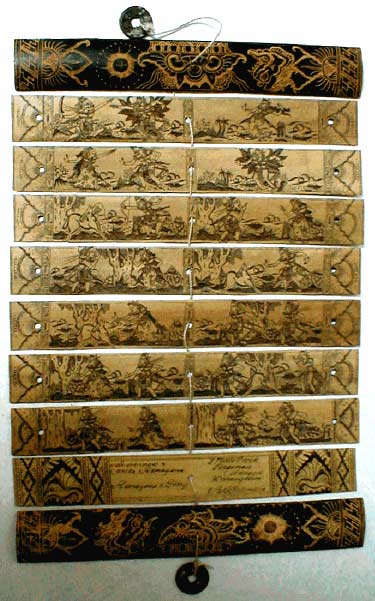
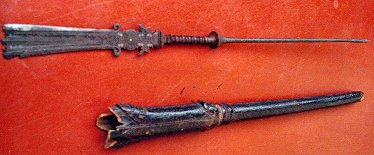
Folded into thirds lengthwise, the A4-sized leaflet was like a modern take on the traditional palm leaf manucripts on which scriptures were recorded for centuries before the printing press was invented. Originating in India, this practice spread across Asia to Sri Lanka, Nepal, Bali, Xishuangbanna (Sipsongpanna, Yunnan), Thailand, Burma, Laos, & Cambodia. In addition to scriptures & jatakas (stories of the past lives of the Buddha), information on disciplines as diverse as rituals & ceremonies, art, dance, music, architecture, medicine, science, agriculture, astronomy, astrology, yoga, martial arts, law, history & economics was also recorded onto such manuscripts by first etching words & drawings onto the treated leaves with a sharp metal stylus, & then rubbing them with pigments made from the soot of oil lamps & various plant extracts to give the engravings colour. What may be summed up as an extremely laborious process of preparing beautiful termite food (which is in itself a lesson in impermanence)...

Thursday, December 25, 2008

281206 flying catfood & rice-eating vehicles

On its way down Phou Si, the cat met locals trying to sell it still fresh & tweeting pre-packaged convenience catfood for lunch...

Many Buddhists believe that one can gain merit through the supposedly compassionate act of releasing flying catfood from cages to the skies & swimming catfood from plastic bags into ponds & rivers. However, merit through 放生 (fang4 sheng4) is supposed to be derived from saving the lives of animals that are facing imminent death (e.g. fish trapped in a pond that is drying up & birds snared for slaughter - see this story - & livestock bound for the abattoir)...rather than animals that have been captured specifically for the purpose of sale & release, leading to the perpetuation of a prolonged cycle of capture-release-capture-release-capture punctuated by spells of imprisonment. See here for a whole debate on the Phou Si catfood sellers.

Vehicles do have sticky rice-chomping ຂວັນ khouan (souls/spirits):

PC280142
PC280143

For man-maid:

PC280148

Because the cat has to try every strange flavour of green tea:

PC280146
PC280147

Monday, November 03, 2008

271206 bindabaat - Luang Prabang version part 2

Continued from part 1...

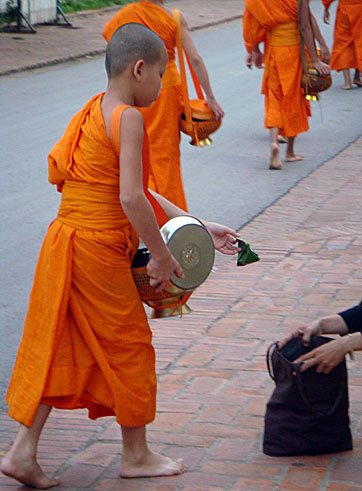
Another impact of tourism on bindabaat lies in the decreasing number of local almsgivers within the peninsula area, where ground zero & many of the temples lie. As property prices increase, locals move out & rent/sell their former homes to operators of guesthouses, hotels, restaurants, cafes, bars & pubs, cooking schools, spas, internet & ipod cafes, travel agencies, souvenir shops & minimarts, etc...leaving behind fewer residents to taak baat (give alms). There is not always enough food to make up two meals per day. Abbots are thus increasingly reluctant to take in additional mouths that would be difficult to feed. As novice 'Spoil Market' said:

There many houses have become a guesthouse, restaurants, and shops around LPB. This is because LPB has become a famous travel city and there is increasing lot of tourists every day. For my temple now there haven’t enough food some time, almost [his word for 'mostly'] it’s in lunch time.

There are two families
[from his village] that have sent their sons to be novice, but their sons stay at the temple far from in the town centre. Because the temples around the town is full. So, it's quite difficult for them to come to Monk school, and I think if possible when I leave the temple I'll help them to stay my temple. Because it’s near and convenient for their studies.

The cat would realise the extent of this problem in 2008, when monk Tata Young-fan casually mentioned to it & the vice-abbot of a Thai temple that he was a good cook, having honed his skills cooking lunch for his Luang Prabang temple whenever they didn't collect enough during bindabaat...both the vice-abbot & cat had the same ?!khuubaa Lao are allowed to cook?! reaction...& the vice-abbot was quick to emphasise to the cat that Thai Theravada monks do not cook, unlike Lao monks who were forced to do so when laypeople were forbidden to give alms in the aftermath of the 1975 revolution. Despite this shortage, many monks & novices in Luang Prabang were seen reaching into their alms bowls & giving food to the kids who gather at the 'monk shooting' hotspots to beg for alms. One who has been hungry before easily understands the hunger of others?

Some tourists have wondered why the monks & novices seem to receive nothing much else apart from rice. Unlike in Thailand, the monks & novices are not accompanied by temple boys who help to carry offerings that cannot fit into their alms bowls, except on special days like Boun Ok Phansa. Instead, laypeople bring curries, meat dishes, soups & desserts, etc in tiffin carriers & pots directly to temples. Few tourists notice this, & some have tried to 'add variety' to the monks' & novices' diet by giving them stuff like Snickers bars, Oreo cookies & Lays potato chips. Such items do get offered as alms in Thailand, but in small packages - for a good reason. A Luang Prabang novice had a falang stuff his alms bowl with a giant bag of potato chips, & not even a pinch of sticky rice could be placed into it after that. He had to walk on lid in hand, unable to cover his bowl, & collected nothing else!


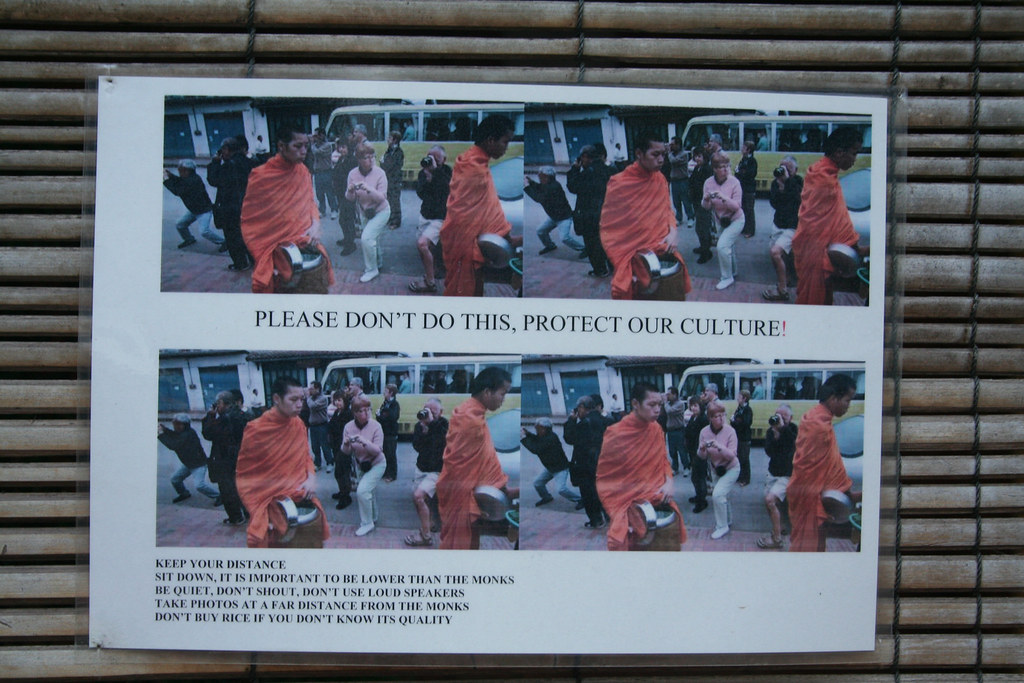
In 2008, this photo appeared in this article, & was subsequently used for new signs advising tourists on the appropriate etiquette to be observed during bindabaat. The cat visited Luang Prabang again, & found that areas that had previously been relatively low key had morphed into hotspots too:

PA140432
PA140440

~2 years ago AOT was a novice following behind, now he is a full-fledged monk & one of the remaining three of his temple (BP, DT, Tata Young-fan, SS, DKS, ST & the previous abbot all having left) leading their line back to safety after yet another morning of running the gauntlet:

PA140445

Back then CT was a 'year old' novice hiding behind his two elder brothers in this line, now he's a lot more experienced & used to dealing with this craziness, & it's younger brother TT who's now the 'year old' novice hiding behind him :) Perhaps this is a good training - learning how to remain focused & undisturbed when surrounded by distraction that borders on the overwhelming.

Things are getting out of hand, but at the same time awareness of the problems appears to be increasing. It is wonderful & heartening to see tourists who make the effort to do things the proper way, like this, this, this, this & even this (all dressed in white like Theravada Buddhist laypeople who stay in the temple while observing 8 precepts!), & also guesthouse owners & tour guides who show their customers the right way to give alms, & photographers who try to be mindful of their own actions:

Among the guidelines he broke included standing in the way of the monks as they passed, using flash right in their faces and standing above them as they walked by (he got on a chair to try to get a different angle of the scene). I watched him get right up in the faces of the people there and fire off his flash and hardly move out of the way at all when a monk was trying to proceed along the path.

It's photographers like him who make my job harder. No wonder there is a lot of distrust of photographers around the world - a lot of obnoxious jerks have blazed trails that every subsequent traveler has to navigate.

Maybe he got some good shots from his insensitive technique. Maybe his flash did a better job of capturing the scene than my high ISO settings. Maybe he got a good angle from standing on a chair. But I don't want to be that guy. I don't want to be the photographer who makes himself into an arrogant fool to get a shot (I mean really, I look silly enough with my two cameras around my neck). I mean, isn't part of the challenge of getting a good shot to do it while respecting your subject and the people around you?


Perhaps tourists who wish to participate in the alms giving could combine it with other attractions of Luang Prabang - support local weavers by buying a handwoven scarf (& even a Lao sinh) as a souvenir at the night market or Talat Phousy & respect tradition by wearing it for taak baat + buy freshly-steamed rice & other food offerings from the morning food market near Wat Phonexay, while at the same time exploring it to see what Lao people really eat...& even stay in local family-owned guesthouses & help their guesthouse owners prepare food for the temples, & learn how to make banana leaf offerings...all ways of gaining a more meaningful experience while supporting the temples that they have come to see & contributing to the local economy?

As increasing numbers of Western tourists participate in the giving of alms, the sight of falang taak baat might well emerge as a new attraction for Lao & other Asian tourists ;)