Showing posts with label wat saen. Show all posts

Wednesday, December 24, 2008

281206 Wat Saen - red Buddha & nescafe broom

Incomplete - the monk who was making it decided to return to lay life:

PC280085

Nescafe broom:

PC280086

Lotus hideout:

PC280061
PC280060

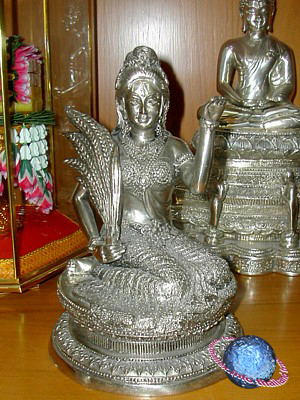
Anyone knows who the lady at below left is?

PA140415-7

Resembles the rice goddess แม่โพสพ Mae Phosop, but she isn't holding a sheaf of rice plants...& also looks like the Beckoning Lady นางกวัก Nang Kwak, but she doesn't have one hand raised in maneki-neko style to attract fortune...

At the base of a bamboo pole holding up a long banner:

PC280109
PC280107
PA140443

281206 Wat Saen - Buddha footprint

Photos from October 2008 trip...

PA140420

The 'twin miracles' (ยมกปาฏิหาริย์ yamaka patihariya):

PA140421

On hearing that Buddha was to perform a miracle at a mango tree, disbelievers wanting to discredit him bought over all mango orchards & cut down every single tree. Buddha then ate a mango & had the king's gardener Ganda plant the seed. A fully grown tree sprouted instantly, at which Buddha created double apparitions of himself, depicted as one pair each of reclining & sitting Buddhas in the tree.

It is widely believed that Buddha forbade his followers from making any paintings or sculptures of him after his death, & this is the reason why early Buddhist art is aniconic, where Buddha was represented by symbols like an empty throne, a Bodhi tree, or his footprint instead. This is the reason why Buddha footprints, many of which can't possibly be actual footprints, are found in places where Buddhism is practised, including countries where there is no record of Gautama Buddha ever having travelled to. The whole idea of footprints as a representation of Buddha probably came from the practise of showing respect by prostrating oneself before the feet of deities & elders. The Buddha footprint (phouthabat) in Wat Saen:

PA140427
PA140429

All five toes of the same length, a Dharmacakra (wheel of Dhamma) in the middle of the sole, & 108 auspicious symbols...

PA140428

...although no matter how the cat tries to count, there seem to be 109...

Tuesday, December 23, 2008

281206 Wat Saen - boat & drum

Ban Wat Saen's longboats:

PA140418

During ບຸນຫໍ່ເຂົ້າປະດັບດິນ Boun Hor Khao Padap Din (lit. festival wrap rice decorate earth) on the new moon day around late August/early September, Luang Prabang's annual longboat races (ຊວງເຣືອຍາວ suang heua yao) are held on the Nam Khan. People leave offerings of hor khao (little packages of rice wrapped up & steamed in banana leaves) around their homes & temple grounds for the spirits of the deceased, & 'boats' made from banana tree stems (looks like triangular, leaf-less & flower-less krathong) are floated on the river or left on the banks at various sites along the Nam Khong & Nam Khan where nagas are believed to live.

PA140418a

Each boat is believed to have two female khouan (spirits) called Nang Heua (lit. Miss/Lady boat) in it, so offerings have to be made before the boats can be used:

PA140416

Interesting how the timing of this festival overlaps with 七月 (seventh month in the Chinese lunar calendar aka. 中元节 Hungry Ghosts festival), & shares the same elements of making food offerings to the spirits of deceased relatives...the Thai version described here shares even more similarities - the whole idea of the gates of hell being opened for the whole month for spirits of the dead to roam the mortal world & enjoy the food offerings & entertainment provided by the living to appease them. Not sure if it's only Luang Prabang town that holds boat races at this time of the year - Ban Xieng Ngeun further up the Nam Khan, Vientiane & elsewhere in northeast Thailand (e.g. Sakon Nakhon) have theirs in October during Boun Ok Phansa (end of Buddhist Lent/rains retreat) instead.

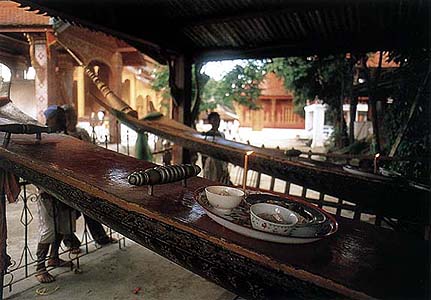
Wat Saen's alarm clock doubles up as a car shelter:

PA140431
PC280098

Sunday, December 21, 2008

281206 Wat Saen - big bird, eating house

The building (below, left) beside the viharn, which a laomeow consultant refers to as an 'eating house':

PC280078

According to him: it use for meeting and chanting, some time there's a special ceremony they will have a meal inside. It looks like small but its inside is quite large and it's easy to walk. this is because there has no too much statue inside.

Click here to watch someone's video of this building in use during the former abbot's wake. The roof is supported by eave brackets less elaborate in design than that of the vihaan...

PC280093

...& the stairs lack balustrades - no fish-wielding makara here:

PC280079

One of the two buildings directly behind the viharn:

PA140433

Not sure who exactly the four-faced Pha Phom (Brahma) & other deities are worshipping:

PA140434

The central figure is sitting upon a lotus flower & resting his foot on a smaller bloom, but is still wearing a crown & the clothing of a prince, & lacks a halo around his head...might he be Maitreya (aka. Ariya Mettayya), the future & fifth Buddha of the present universe?

The other building directly behind the viharn:

PA140437

Two white nagas twirling in a beautiful way:

PA140437a

Buddha stepping on a hermit:

PA140437b

In a previous life, the future Gautama Buddha was Sumedha, the only son of a rich couple in the city of Amaravati, who gave away all his inherited wealth & became a hermit in the forest. On hearing that the Dipankara Buddha (aka. พระทีปังกรพุทธเจ้า Thipangkon Buddha) was coming to Amaravati, Sumedha set about repairing the road in preparation for his arrival. However, he was unable to finish in time, & prostrated across the muddy incomplete section, offering his own body as a bridge (above left). Dipankara Buddha then predicted that Sumedha would one day be reborn as a Buddha himself (above right).

A new addition spotted during the cat's 2008 visit - once the previous abbot's funeral carriage, now a gradually crumbling monument to impermanence:

PA140435

Saturday, December 20, 2008

281206 Wat Saen SPECIAL - *CAT edition*

PC280073
PC280074
PC280069
PC280068

ใบเสมา bai sema - used to demarcate the consecrated area of the temple:

PC280077

281206 Wat Saen - the makara that got the fish...

PA140438
PA140440b
PC280084

& the sour puss that didn't...

PC280072

The fish-tailed, crocodile-like makara is the mount of Ganga (Hindu goddess of the Ganges river in India) & Varuna (Vedic god of the ocean). In Lao & Thai Buddhist architecture, makara are usually depicted with multi-headed nagas sprouting from their open mouths, but these guys here are either going hungry or *MUNCH* *BURP* have already gobbled up theirs...

281206 Wat Saen - windows

PC280087
PC280076
PA140438a
PC280094
PA140432
PA140436a
PA140436

281206 Wat Saen - viharn

From top to bottom, Wat Saen Soukharam in Tham script, Lao script, & English:

PA140440a

The viharn as seen from the corner where the Buddha statue of the erstwhile Wat Pha Chao now stands:

PC280063
PC280063a

On the right is a smaller, simpler building used by monks as a meeting hall:

PC280059

Once a fortnight, on the 1st & 15th days of the lunar calendar (new moon & full moon, or wan sin nyai), full monks gather for the recitation of the bhikkhu patimokkha, known to laymen as the 227 rules for Theravada monks (Tibetan monks have 253 rules, & there is also a bhikkhuni patimokkha with 311 rules for Theravada nuns & as many as 380 for Mahisasaka nuns). The patimokkha is found in the Vinaya Pitaka, the section of the Tripitaka (Buddhist canon of scriptures) concerning the discipline of monks & nuns, & the Lao & Thai word for 'discipline' (winai) comes from the word Vinaya.

During these sessions, monks confess to one another if they have broken any of the rules. The patimokkha recitation thus requires a quorum of four monks, but quite a few temples in Luang Prabang have fewer than four resident monks. This is overcome by having all monks in town assemble at two centrally-located temples in the morning for combined recitations, & one of the venues is Wat Saen.

PC280100
PC280100a

Not the Lao national football team:

PC280100b

At the time of the cat's first visit, the abbot of Wat Saen was the most respected Venerable Pha Khamchan Virajitta Mahathera, the chief monk of the northern provinces of Laos. Seven months later, he passed away. On the cat's second visit almost two years later, the urn-shaped wooden structure used to cover his casket during his funeral ceremony was sitting outside the side door of the viharn:

PA140442

Beneath the roof of the verandah:

PC280104
PC280101
PC280102